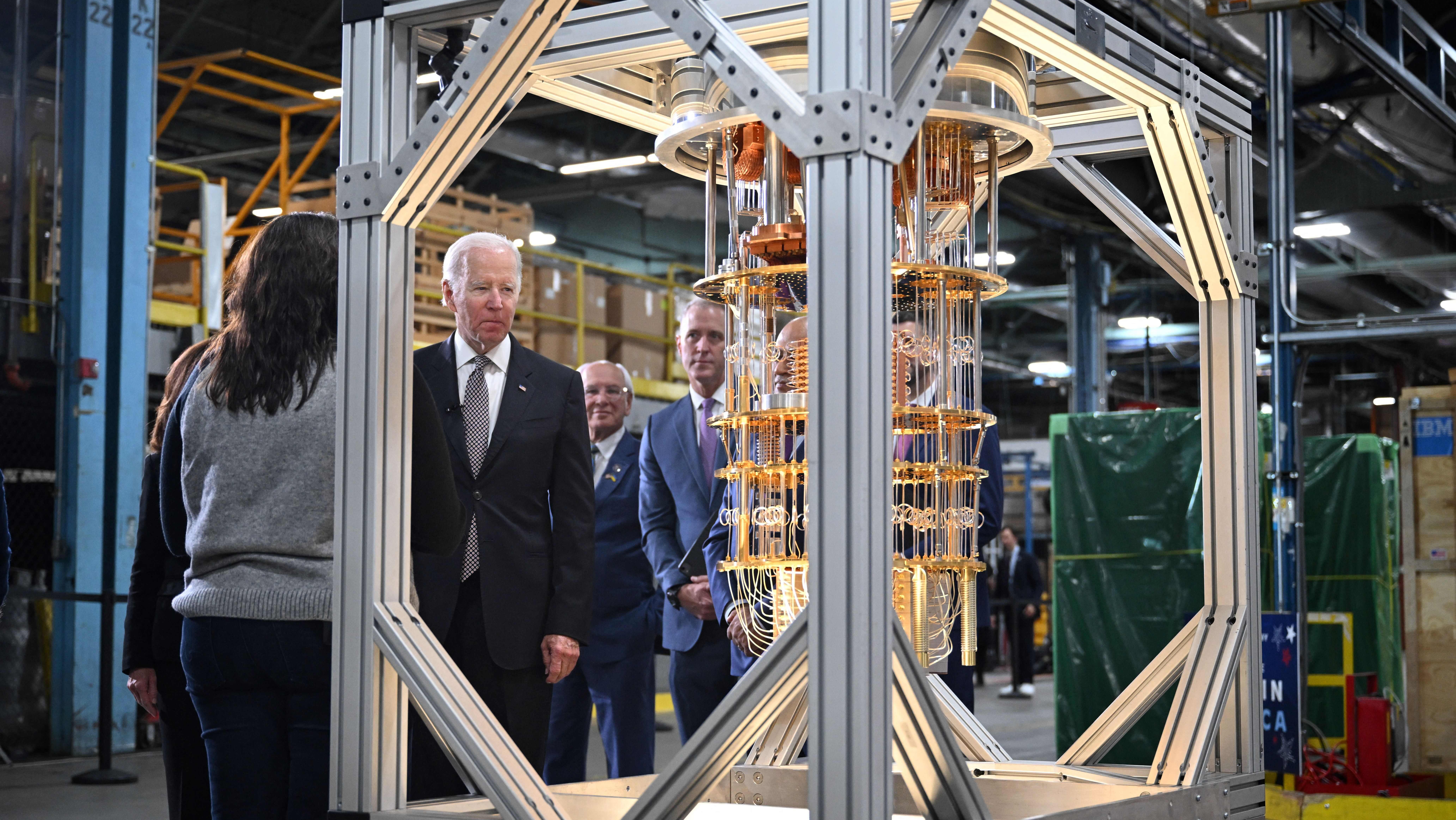
Congress should establish, fund new quantum tech initiative to beat China: Panel
The 2025 annual US-China Commission report also urges lawmakers bolster funding to the US Space Force to establish "space superiority" against the PLA.
The Air Force Research Lab’s award to the NYC-based startup is also a vote of confidence in the idea of using quantum particles for secure communications — an idea of which the NSA has long been skeptical.
The deal gives AFRL scientists access to manufacturing tools developed by PsiQuantum and GlobalFoundries, allowing them to build experimental designs for barium titanate chips that use particles of light instead of electricity.
"The number of companies that we're announcing is a surprise to me," program manager Joe Altepeter told Breaking Defense. "I did not expect we would get this many.”
Quantum tech could provide high-precision alternatives to GPS for targeting or sonar for hunting submarines. But the same hyper-sensitivity that makes them such good sensors also makes them fatally vulnerable to interference — so far. A new DARPA program aims to change that.
In March, DARPA will add multiple companies to its Quantum Benchmarking Initiative, program manager Joe Altepeter told Breaking Defense. “A year from now we’ll know a lot more about if this industry is for real or not.”
“We've got to think ahead as to what the adversary might be working on and develop algorithms that are there in time to meet the adversary's ability to crack those algorithms,” David McKeown, deputy DoD CIO, said.
“We're going to do our best to disprove anybody who steps through our door,” said DARPA’s Joe Altepeter, “[but if] you convince my team, we will be your advocate inside the government, in rooms you can’t go.”
“This is the starting gun for what may be the single largest overhaul of US government communication systems since the adoption of the Internet, as ordered by the President in National Security Memorandum 10,” said RAND scientist Edward Parker. “It will probably go on for decades and will cost billions of dollars.”
In this op-ed, Rebecca Grant outlines the reasons the Defense Department should consider appointing a Principal Quantum Adviser.
It's been a whirlwind of a year — and the defense establishment has plenty of thoughts on how it's unfolded and what might come next.
Tech giants and venture capitalists are pouring billions into developing quantum computers. But related tech of special interest to the military — quantum sensing, navigation and communications — needs stepped-up federal funding, the Air Force Association says.
The National Institute of Standards & Technology is about to release its long-awaited "post-quantum encryption" algorithms. Then comes the hard part: installing them everywhere.
Quantum bits are potentially powerful but notoriously error-prone. Now a Harvard team says it has found a way to prevent mistakes — by manipulating individual atoms with laser beams — making quantum processing much more efficient.
Led by a core team of industry partners including MBDA, Leonardo, Thales, Roxel, Safran and CEA, technology areas are designed to support a variety of use cases which include tactical and deep strike, surface and force protection, and air dominance.